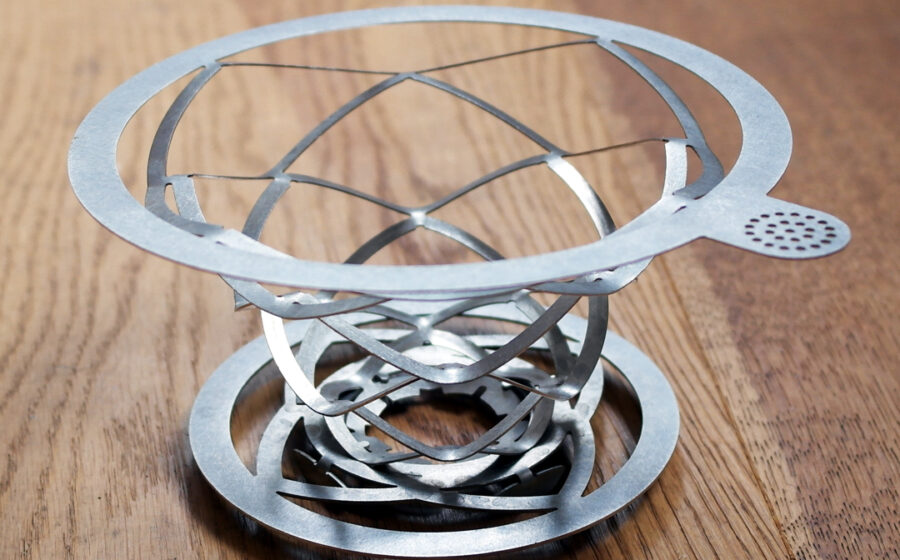
[P]our-over coffee is most commonly criticized for its variability. It’s difficult for even the most seasoned pour-over enthusiasts to get a consistent brew, which implies a compromise in quality, too. A new pour-over method from London’s Bairro Alto, a design team inspired by the art and architecture of Lisbon, was designed with that variability in mind.
AltoAir is a very different kind of pour-over. It’s barely there; a skeleton of the pour-over we know so well, but the non-existent walls of AltoAir (a minimalist lattice framework holds the filter in place) are also the secret to its claims of consistent extraction.
Without the entire surface area of the filter covered by the pour-over, AltoAir seeks to reduce blockages, filter-sticking, and a slow flow rate. The filter cannot stick to what is not there. The result, according to Bairro Alto, is an unhindered brew, and an interesting one to look at.
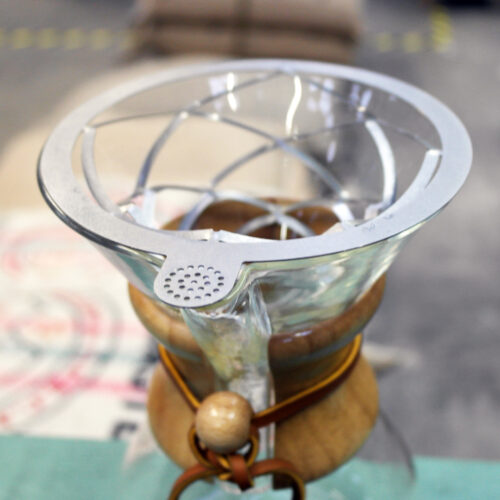 The name supports the idea that AltoAir is an open-air brewer. Without filter-hugging walls, the extraction process is merely suspended in midair by the device’s delicate frame. While it may look like it wants to collapse, and might be good for traveling, don’t be fooled by AltoAir’s thin, radial supports. The fragile-looking pour-over isn’t a sometimes pour-over, simple for the sake of being simple. It’s a sturdy art piece, one with a mission of consistent, unhindered brews.
AltoAir is crafted in stainless steel and dishwasher safe, it’s compatible with regular cone filters, and fits easily into a Chemex. In other words, if its claims of better manual brewing stand up to coffee’s finicky nature and particular baristas—only time will tell—we might be seeing more pour-overs that are fun to look at, and barely there.
—Regan Crisp is Fresh Cup’s Associate Editor.